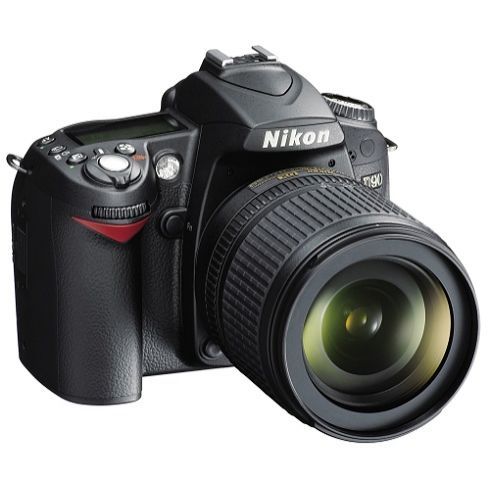
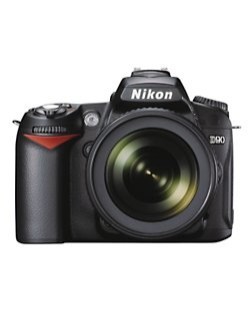
Bought the Nikon D90 in Jan.'09 as an upgrade to my much loved D80. Right out of the box I noted a major improvement in image sharpness. It’s unusually fast as well, able to fire numerous JPEGs in a single burst when using a fast SDHC card.I really like the new feature of 3D Focus Tracking in continuous autofocus mode for great reliability with action subjects.
The D-Movie mode is fun and I found it useful for shooting clips during family events using a VR lens (with image stabilizer) to correct for camera shake. As long as I did not pan too quickly, video quality was very good.
the Scene Recognition feature. Most of the “post processing” options are quite intuitive.
During extensive nature, action, travel and portrait photography, I found the D90 to be unusually fast, reliable and versatile. While HD video capture will not be of interest to everyone, the Nikon D90 is a very desirable camera in more conventional aspects, making it a perfect choice for photography enthusiasts.
I love it,In terms of image quality I'm impressed. Highly recommend this camera.
Rick
Strengths:
Dreamy CMOS sensor
Very fast phase-detection AF
Live view mode
Matrix metering
Amazing battery life
Low light capture capabilities,Low noise
Auto D-Lighting mode
Auto iso mode
Auto White Balance mode
Consistent,accurate exposure
Bright,BIG viewfinder.
3" display monitor
In-camera sensor cleaning
High speed shooting mode
3D focus tracking
In-camera retouching
Scene Recognition feature
Weaknesses:
Very slow auto focus in live-view
No AF in D-Video mode.
Video quality could be improved
Loud shutter
Small hand grip
Capture NX 2 not included
Traded in an D70s for a D90. Was looking at the outgoing D80 but found that besides the higher mpix count, the other features were too close to the 70 so went with the newer 90.
Buyers beware:
1. The suggested retail price is only a guideline. Even in a recession some stores will sell a bit cheaper to get more product out the door.
2. Throw-in or extra: depending on the store. If the store have a very low advertised price, chances are they won't throw in anything extra. If a store sells the camera at a higher price, you have room to negotiate.
The items you are most likely to buy extra: a camera bag, a neck carrying strap, a memory card & a filter for your new lens (at least a UV). Besides the memory card the other 3 are good to have but not a necessity. Even a memory card you can negotiate with the vendor or buy it at an electronic store for cheaper.
3. The package deal: camera with lens together. Usually 18-55 or 18-105 Nikkor lens. If you want to keep a lens still usable from your previous trade-in, the retailer may not give you as good a deal. Nikon knows the D90 allows you to use other lenses (Sigma, Tamron, Tokina) but to get you to buy a Nikkor with your new digital they temp you to go for the deal. You get a large (tall) box with lots of packaging inside: the SLR, battery, software and a Nikkor lens on top.
2 things was looking for:
1. Air filter. Even with occasional lens changes, the camera sensor on the D70s acts like a magnet and attract dust that shows up in your final pics.
2. Live Preview. For shooting at odd angles where you don't need your eyes on the viewfinder. Occasionally you are behind a crowd of people and wants to shoot over people's heads you can at least see what you're getting.
The Live Preview turns on & off with the mirror-lock.
Strengths:
1. Large viewer. On the D70s found picture sharpness was occasionally a problem. At least with a large enough viewer you can see your pics well-enough beforehand so you can take the picture again until you get a good shot. Otherwise you enlarge it on the computer or TV later and found that it is a touch out of focus you missed the shot.
2. Air filter. You still need to blow the back of the lens occasionally to remove dust but at least dust won't be picked up by the sensor.
3. Size. Compared to D40 & 60 some people may find this camera a bit on the heavy side but not as much as the 300 & & 700. Compared to the D70 they did manage to trim a fraction of an inch off the length and still offer more features than the older SLR.
4. ISO: from 100-6400. The standard settings are 200-3200. On the 2 ends instead of labeling them as 100 & 6400 Nikon labeled them as Lo 1.0 & Hi 1.0
5. Movie mode convenient: turn your Preview on, press [OK] instead of your shutter release and you can start recording your movie right away.
6. Zooming the scene up & down: conveniently by 2 lower-left buttons
7. WB: included an extra K (color temperature setting) when used with Preview on allows you to match with the saturation of the scene (not too warm or cold).
Weaknesses:
1. Certain buttons can only activate with the Live Preview off: the WB can be adjusted either way. After taking a shot you press the Play button or while taking the shot you wish to adjust your ISO your Preview must be off... otherwise won't work. A bit of inconvenience pressing an extra button.
2. Live Preview: can still be improved. Several years ago used a Canon S45 P&S digital (on the same line as S70 & S90). Was on vacation with the S45 and a film SLR. Took a few shots in a hazy morning with a low sun. The preview on the S45 saved the day. The preview allowed you to see your exposure changes as you adjusted it manually on M or by compensation -2, -1, +1, +2, etc. On the D90 however, the viewer doesn't track exposure changes (only the changes to the White Balance). When you are doing action shots you don't have time to take the picture again if the exposure is off.
A bit of time-lag between taking the picture and when the Preview is switched on again. If you set the [Image review] to on, you get a 4s delay. Even the Image review feature is turned off, after taking a picture there a 1.5s delay. And after every shot the Preview turns back on, you get a distracting loud click as if you just took another shot. Actually it is just your mirror moving back up to the lock position.
3. Paying for the privilege to use 3rd-party lenses: Nikon knows their lenses are more expensive and that they're not always better than a 3rd-party equivalent. A lower down SLR such as a D40 or D60 you get enough mpix for a good shot but must use Nikkor lenses or some of the lens features such as auto-focus may not work. Here you are paying a few hundred more so that you have the option of using Sigma, Tamron, Tokina and other brands.
4. VR: can be useful in low-light or with long lenses. Considered cameras such as Sony Alpha with Vibration Reduction in the body better because you can put any lens on top and still be able to get the shake-reduction. Canon & Nikon people with their Anti-Shake feature on the lens will tell you that you get a better performance if the vibration feature is calibrated for each specific lens.
Sony took over Minolta a few years back and adopted the Maxxum technology. You can supposedly still use an old Maxxum AF lens (that came with your film camera) with your new Alpha and still get Vibration Reduction. With a Nikon, you'd need a VR lens to get the feature.
5. Price: compared to other SLR manufacturers such as Canon, Sony & Olympus tend to consider Nikon a bit over-priced. They are counting on their good name and reputation to do the sales pitch so even in a recession tend not to reduce the price of their products as aggressively.
I have used the Nikon for 3 months now. I've taken some great pictures and some not so good pictures while I experiment with the variety of settings it offers. One feature I find myself using very often, almost automatic now, is the "white balance". I'm hooked and just bought a new prime lens for good portrait photography. Highly recommend the Nikon D90.
The D90 offers superb picture quality, and the ability to shoot short HD movie clips. It was the first D-SLR to offer video. But it's not a camcorder, too many limitations, but a nice, flexible model for photojournalists.
Strengths:
The Nikon D90 is one hell of a DSLR. When you consider that the image quality is comparable to the D300, then it’s clearly a smart choice for professionals who want to save a buck. It also makes an ideal choice as a backup camera. Factor in the D90’s ability to shoot 24 fps video and it’s a no-brainier for photojournalists. (Note: Canon jumped on the bandwagon, but Nikon was first.)
The D90 is fast, very responsive. Great build, feels substantial. Has a comfortable grip, well-placed controls, and a gorgeous 3? LCD monitor. No lag time when shooting RAW and JPEG files to the SDHC card.
I haven’t shot any videos yet, but from what I’ve heard it’s clear that the D90 doesn’t replace a camcorder. There are simply too many limitations, like not being able to use an external mic and being limited to shooting five minute clips. Panning without a tripod doesn’t cut it, either, unless you’re going for wobbly funhouse mirror effects.
That said, there are work-arounds for these issues. For example, if you want quality audio you can record your soundtrack independently with a digital audio recorder like the Edirol R-09.
It’ll be interesting to see what Nikon does with future DV-capable models.
I bought the D90 body without the kit lens and instead sprang for the 18-200mm AF-S DX VR zoom which adds considerable weight to the D90 body. I’ve ordered the MB-D80 battery pack which should balance the weight of the zoom.
The 18-200mm is not super fast (3.5 - 5.6) but fast enough. It’s an ideal walk-around lens, and a good choice if you don’t want to lug around two cameras or have to change lenses in the field.
The ISO range of the D90 is 100 to a whopping 6400.
There are plenty of features to be tested such as the Scene Recognition System, Live View, 3D focus-tracking, on and on,
Just my first impressions.
Weaknesses:
Video capacity is limited. No plug for an external mic.