

Nikon D700 Digital SLRs


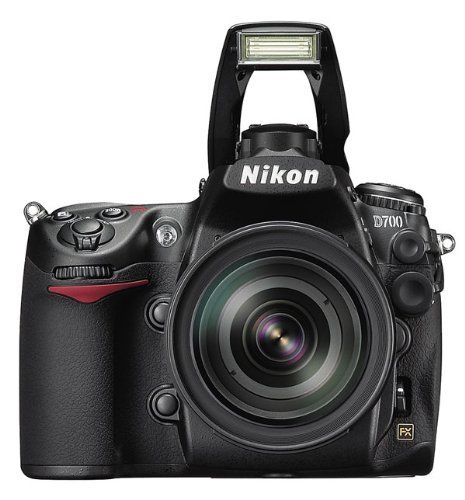
Nikon D700 Digital SLRs
USER REVIEWS
|
[Jan 03, 2011]
Prettym1k3
Professional
Strength:
Low light capabilities, full frame sensor, clean high ISO settings, button placement, depth of focus, beautiful screen, customizable menus, focus tracking, metering.
Weakness:
I don't use video, but I can see that some people might see this camera not having video capabilities as a weakness. Otherwise, I see none. Although I do think that it would have been cool if this camera had 8fps without the battery grip, and dual card slots. Dual card slots would have been awesome. I dropped the hammer. I cut ties with DX (crop sensor). And I did it. I went full frame. I could tell you about the high ISO capabilities, the larger view finder, the low light ability, the amazing depth of focus, the fast response time, the well place buttons, the user friendliness, the customizable menus and buttons. But I won't bore you... unless I just did. Hold this camera and prepared to have your mind BLOWN. Customer Service Haven't needed customer service yet. The camera is brand new. If it's anything like my D300 or my D90, I won't need customer service. Similar Products Used: D40, D90, D300. |
|
[Dec 22, 2010]
Danbaileyphoto
Professional
Strength:
Compact- for carrying into the backcountry.
Weakness:
If it has any, it would be that it doesn't shoot as high FPS as the D300, but this is made up for with the fact that it shoots 14-bit RAW at full speed 5 FPS.
I've owned this camera since March and I have to say that after using the D200 and D300, this is by far the best digital camera that I've ever owned. As a full time pro, I need gear that works- i.e. that gets me the shot and stands up to abuse.
Customer Service Never had any issues with this camera, although I've sent gear back to Nikon to be fixed and they did it in a timely manner. Similar Products Used: D200
|
|
[Jun 25, 2010]
GB1
Intermediate
Strength:
Picture quality - The 700's photos seem sharper and better balanced than the D200's. When I pull them into my digital image software, I have very little to edit exposure wise and sharpening is sometimes not even necessary at all (!)
Weakness:
The D700 does so much so well that it's hard to find weaknesses, but here's a few wishes:
Bought the D700 because I needed a full (35mm) frame (FX) digital SLR. Plus I wanted a little better dynamic range than the D200 offered, which I owned.
Customer Service Haven't used them. Similar Products Used: The Nikon D200. |
|
[Jun 19, 2010]
mattbikeboy
Professional
Strength:
1) Image quality
Weakness:
1) Heavy -- it's a piece of pro equipment and built to handle heavy use -- but can be pretty heavy when shooting 8-10 hours a day. ;) I'll mention right off that I love this body. I shoot and edit hundreds of frames everyday on this camera and love the image quality in the images. The low light light (high ISO) performance is awesome for bodies in this price range. The image quality is as good or better than the 5DmkII in every situation. Customer Service Most of the time -- very good. But when they don't get things right the customer service is truly awful. I'm pretty mellow and love working as a full time professional photographer after years in the design industry but getting told they can't find my equipment that they have been servicing, then getting hung up on and being subjected to the service operator whining in Spanish after I ask to talk to a supervisor -- is not professional and very, very, very poor customer service. Similar Products Used: Nikon D80, Nikon D3, Nikon D3s, Canon 5d, Canon 5d mkII |
|
[Mar 11, 2010]
davethursfield
Professional
Strength:
Build quality is excellent, it is compatible with the whole of my Nikon system. It also uses the same sensor as D3 in a better sized body, and is good enough for regular Professional use.
Weakness:
Quite heavy in use, but much lighter than a D3. The dedicated function button is a little close to the depth of field button. A fine Camera for low light situations where a tripod is not available. |
|
[Aug 11, 2009]
donnnnnny
Intermediate
Strength:
high end iso results, fast shutter speeds with battery grip, sturdy strong build, great auto focus ease of menu use 51point auto focus. fx sensor and sensor cleaner
Weakness:
fussy man dial at the rear which keeps trying to show me shooting data when im flicking though my shots.
I have just moved up from my faithful D80 which is still in the bag
Customer Service not required Similar Products Used: Nikon d80 |
|
[Mar 22, 2009]
Teru Rinshou
Intermediate
Strength:
Fantastic ISO performance
Weakness:
Not really weaknesses, but just a small wish list of features that would suit my needs a little more:
Build
Customer Service Not needed so far. Similar Products Used: Nikon D70, D80 |
|
[Dec 10, 2008]
Old Timer
Intermediate
Strength:
Full Frame sensor
Weakness:
Rather heavy with grip and batteries
The D700 is my forth Nikon digital camera in the last 4 years and is by far the best of the lot. I started with the D70 add a D2h for sports and replaced the D70 with a D200 in 2006. When the D700 full frame Nikon was announced I knew I would have to give it a try. I had no idea I would do it so soon. I had planned to purchase it in mid 2009 but moved up the date when the price came down faster with the rebate than I had anticipated. i think it was the best decision in camera purchases that I have ever made.
Customer Service No need for customer service with this camera yet but have with the D70 and the D2h. Nikon service was fast and dependable both times. Quick turn around and problems completely resolved at no cost both times. Similar Products Used: D70, D2h, D200 |
|
[Dec 08, 2008]
picture04
Intermediate
Strength:
I use the Nikon D700 for low light engineering type situations and I find the quality of image is very good using a higher ISO number to compenstate for low or close to no available light.
Weakness:
None to date. Having used a beautiful Canon T90 for many years, with great results, I switched to a Nikon D200 three years ago. I found it to be a very good camera. I got bitten by the digital bug and earlier this year I went for a Nikon D700 and I absolutly love it's 5 star quality.
Customer Service At purchase the dealer's representative was fantastic. Very helpful and was fully immersed in wanting me to really appreciate the D700 strenghts. He explained all controls and operational details fully.
Similar Products Used: Nikon D80 on-loan.
|
|
[Sep 21, 2008]
sfpeter
Intermediate
Strength:
Mainly it's the big sensor and incredible ISO performance. I've been able to shoot at ISO 1600 and get completely clean results, and at ISO 4000 in fair-good light only requiring a little cleanup to use. The burst speed is good as is, and great with the battery grip.
Weakness:
It's expensive, but worth it if you need it.
While expensive, this is probably the best purchase I've made in cameras, and which I'll hope to keep for several years to come. Customer Service Haven't had to use it yet. Similar Products Used: D50, D200. |